

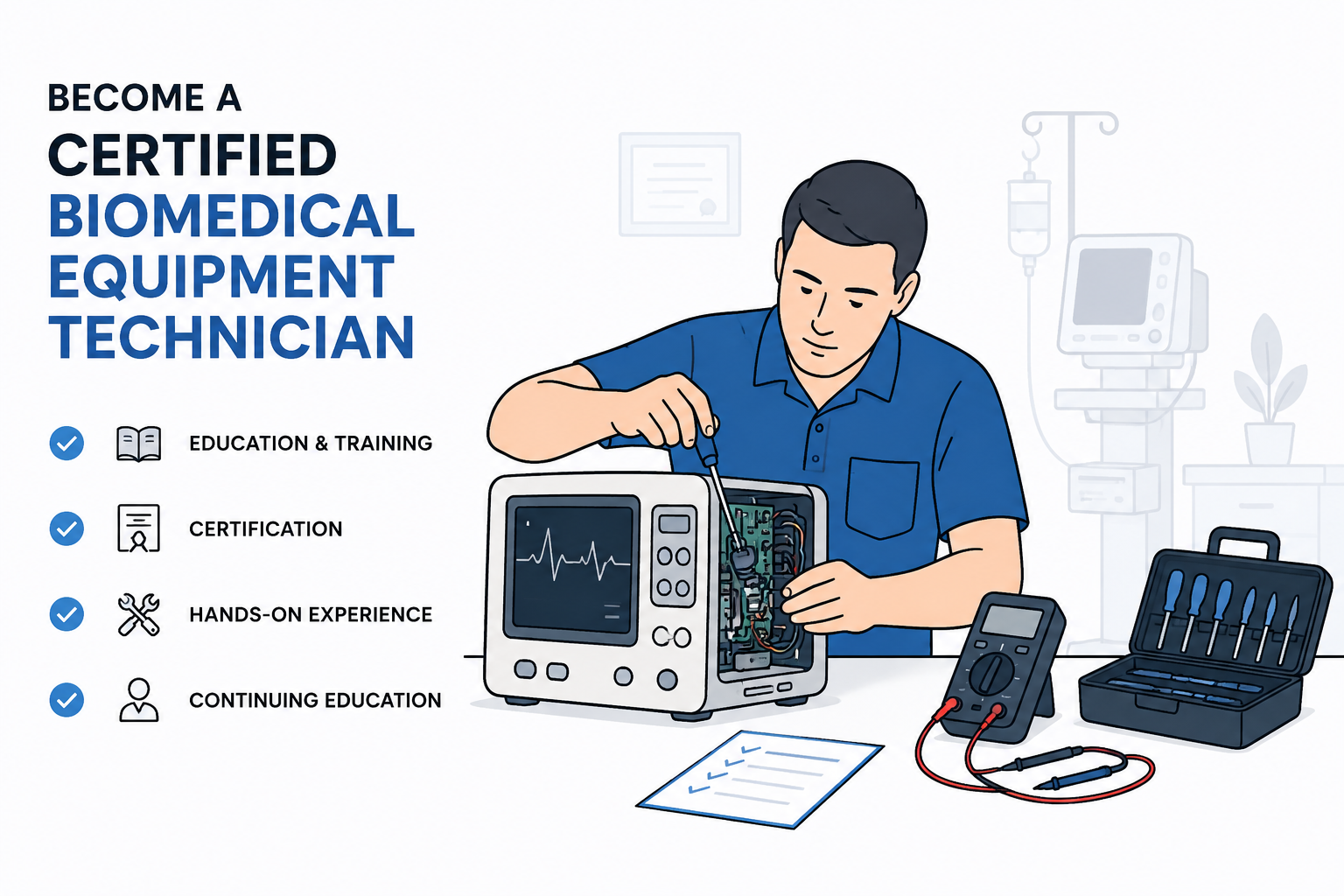
Medical equipment is the cornerstone of the modern healthcare system. However, medical devices and instruments do not maintain life on their own. They require meticulous day-to-day operation, calibration, and periodic major servicing to ensure reliable performance. This is where Biomedical Equipment Technicians come in with highly specialized professionals who perform a wide range of services related to the maintenance and repair of medical equipment.
At Midwest Biomedical Technologies, for years we have been servicing, maintaining, and upgrading imaging and biomedical equipment for medical facilities in the Midwest. When hospital administrators or our aspiring colleagues ask us what it takes to succeed at this type of work, we always give the same answer. To have a successful biomedical engineering career, one needs to have a certain understanding of mechanics, IT-networking technologies, and patient safety regulations.
If you are thinking of making a career out of healthcare technology management (HTM), below are the areas that you need to gain knowledge about to become a certified BMET.
How do you become a certified BMET?
To become a certified Biomedical Equipment Technician (BMET) you need to get a full-time BMET job doing repairs and pass the CBET exam offered by the Association for the Advancement of Medical Instrumentation (AAMI). People usually become BMETs by studying associate’s degrees in biomedical technology or electronics, undertaking military BMET training, or completing entry-level apprenticeships. You then have to work for two to four years before you can take up the exam.
What is a Biomedical Equipment Technician?
A Biomedical Equipment Technician (BMET) works with medical devices. They install, maintain, and repair them in order to make sure they are working properly.
BMETs (also called medical equipment repairers or clinical engineers) work at the intersection of technology and patient care. When a defibrillator needs to be tested, a C-arm needs to be calibrated, or a network connected patient monitor is disconnected from the EMR, a BMET is called upon.
The day-to-day responsibilities usually include:
- Performing the scheduled preventive maintenance (PM) in accordance with the regulations of the Joint Commission and CMS.
- Troubleshooting electrical, mechanical, and software malfunctions of clinical equipment.
- Recording all service and equipment history in a computerized maintenance management system (CMMS).
- Educating clinical staff, including nurses, physicians, and technicians, on the proper use of medical technology.
What Are the Education Requirements?
While there is no exact educational path one must take before applying to a job as a biomedical equipment technician, there are certain qualifications that employers are inclined towards. There are three general educational routes to consider:
1. Associate Degree Programs
The most common educational requirement is a two-year associate degree. Many community college or technical school programs offer an Associate of Applied Science degree in Biomedical Equipment Technology. This type of program includes heavy coursework in anatomical sciences and AC/DC electronics plus fluid mechanics and medical language.
2. Military Training
The United States Armed Forces offer some of the most elite biomedical equipment training programs in the country. Having served in the military and received training in the maintenance and repair of biomedical equipment, such experience is directly applicable to the civilian workforce. Hospitals and Independent Service Organizations, such as our company, are always in need of qualified personnel with military training.
3. Electronics or Engineering Degrees
Many technicians come to a specialty with an Associate or Baccalaureate degree in general electronics or mechanical engineering. This is because they do not have the required education in medical fields so they must receive additional training concerning anatomy, infection control, and FDA regulations, but these technicians still have the necessary trouble-shooting skills.
How to Get Certified: The AAMI CBET Process
The most popular certification for a biomedical equipment technician is the one provided by the AAMI Credentials Institute (ACI), known as the Certified Biomedical Equipment Technician. To take the certification exam, one has to satisfy certain educational and professional requirements and pass the test, which consists of 165 multiple-choice questions.
Even though the majority of states do not require a biomedical equipment technician to be certified, the credential demonstrates one’s competencies and devotion to the profession.
Eligibility Pathways
Before you can take the CBET exam, you must meet one of the following criteria:
- An associate degree in biomedical equipment technology plus 2 years of full-time BMET employment.
- Graduation from a US military biomedical equipment technology program plus 2 years of full-time BMET work.
- An associate degree in electronics technology plus 3 years of full-time BMET employment.
- Plus 4 years of full-time BMET experience for those without any of the above.
What is on the CBET Exam?
The exam spans three hours and covers six primary domains of knowledge:
- Healthcare Technology Problem-Solving (30%): Resolving device faults, identifying problems related to software or hardware, and prioritizing repairs.
- Healthcare Technology and Function (30%): Function of diagnostic, therapeutic, and monitoring systems.
- Healthcare Information Technology (17%): The problem-solving approach for wired and wireless networks, EMR, and security.
- Public Safety in the Healthcare Facility (10%): Electrical safety, infection control, CMS and AAMI regulations.
- Anatomy and Physiology (7%): Medical terminology and physiological systems function.
- Fundamentals of Electricity and Electronics (6%): Electronic principles such as current, resistance, and power.
Other Specialized Certifications
As technicians progress, they often specialize. AAMI offers additional credentials for niche expertise:
- CRES: Certified Radiology Equipment Specialist works in the field of X-ray, CT, and MRI equipment.
- CLES: Certified Laboratory Equipment Specialist.
- CABT: Certified associate in biomedical technology is an entry-level certification for individuals who do not have the required experience for a CBET certification.
Essential Skills Every Successful BMET Needs
If you just have technical expertise, it will not make you an elite technician. When we hire engineers at Midwest Biomedical Technologies, we look for a specific skill set that combines technical skills with some soft competencies.
1. Advanced IT and Networking Competency
Medical equipment is no longer purely mechanical. Infusion pumps are upgraded over Wi-Fi. Patient monitors send vital signs directly into the hospital’s network. A BMET today needs to understand IP addressing, network security, and software patch management.
2. Regulatory Compliance Knowledge
You have to know how to properly document services for audits. You should be familiar with the intricacies of the NFPA 99 (Health Care Facilities Code), FDA medical device reporting (MDR), and HIPAA.
3. High-Pressure Problem Solving
When a surgical table fails during a procedure or an imaging system fails in the ER, technicians need to remain calm under pressure, communicate effectively with stressed-out clinicians, and be able to swiftly troubleshoot the issue.
Salary Expectations & Career Outlook (2024–2034)
The demand for biomedical technicians is on a steady rise. According to the Bureau of Labor Statistics (BLS) employment report for 2024-2034, the demand for medical equipment repairers is projected to grow by 13 percent, significantly above the average for all occupations.
- Median Annual Wage (2024): $62,630
- Top 10% Earners: Over $99,290 annually
- Highest Paying Sectors: Hospitals (state, local, and private) lead the way with a median wage of $74,560.
The increased number of aging baby boomers will require an escalation in medical treatments, resulting in the need for more diagnostic and therapeutic equipment that requires maintenance. Therefore, for someone who is interested in job security, HTM is one of the most stable areas of technical expertise to pursue.
At a Glance: Degree vs. Certification vs. On-the-Job Training
Many candidates, however, confuse the different levels and experience. Below you can see the list, which demonstrates how they relate to each other.
| Pathway | What It Is | Time Required | Best For |
| AAS Degree in Biomedical Tech | Formal academic training covering anatomy, electronics, and device function. | 2 Years | Entry-level students want a comprehensive foundation. |
| AAMI CBET Certification | Professional credential validating your expertise and safety knowledge. | 2–4 years of work experience + Exam | Active technicians looking to advance their careers and salary. |
| Original Equipment Manufacturer (OEM) Training | Specific, proprietary training on a single make and model of a device. | 1–3 Weeks per course | Technicians specializing in complex modalities like MRI or CT. |
Career Options: Hospital In-House vs. Independent Service Organizations (ISOs)
As a rule, after being trained, a BMET can work either for a hospital (in-house) or for an Independent Service Organization (ISO).
Working In-House:
You report to the same facility every day. You have become close with the nursing staff. You work with an extensive variety of basic equipment such as beds, wheelchairs, and monitors to name a few. However, budgets can often prevent you from being properly trained on more sophisticated pieces of equipment.
Working for an ISO:
At Midwest Biomedical Technologies our technicians are an independent support staff for facilities throughout the Midwest. Our staff members are referred to as ISO technicians. They provide service at various different medical facilities including clinics, ambulatory surgery centers, imaging centers and nursing homes. The job has a lot of variety. One day you may be doing an electrical safety test at a dialysis facility and the next be repairing a portable X-ray machine.
If your facility is in the process of selecting providers, the insights shared in our blog, How do you choose the right medical equipment repair service for your facility, are a great place to start to understand the benefits of an independent organization.
Common Mistakes Aspiring Technicians Make
- Ignoring the IT Component: Many people enter the technical field to fix cars and to repair electronics. Now the technician is just as likely to be configuring an IP address than he is fixing a car. Do not forget your IT education!
- Rushing the Certification: You cannot take the CBET exam right after school, without the experience. Learn how to do the day to day preventative maintenance and documentation first, because the test isn’t that hard when you have the experience.
- Poor Documentation Habits: A repair is not complete until the paperwork is done. CMS and Joint Commission inspectors care deeply about service logs. If it isn’t documented in the CMMS, then, in the eyes of an auditor, it simply did not happen.
Conclusion & Next Steps
Becoming a certified biomedical equipment technician can take hard work, dedication, and a commitment to learning. Completing the associate degree program or military education, or working towards an apprenticeship will ultimately lead to a career of keeping patients safe.
Earning your CBET is a proud moment in life, a sign that you’ve become one more step closer to being a competent and qualified specialist. With the growing need for networked and highly integrated equipment, the demand for trained and certified professionals will only increase.
Are you a facility manager looking for qualified, specialized biomedical engineers to assist your clinical staff? Don’t leave your patient safety and compliance documentation to chance.
Visit our resources page for more information on healthcare compliance, or contact Midwest Biomedical Technologies to discuss how our direct-to-engineer service programs can help meet your specific equipment needs.
Request Repair | Call Us Directly: (708) 406-9887
Frequently Asked Questions (FAQ)
What is the difference between a biomedical technician and a biomedical engineer?
A biomedical technician is concerned with the maintenance, repair, and calibration of existing medical equipment in a clinical setting. A biomedical engineer works in a research setting to develop new medical devices and technologies.
How hard is the CBET exam?
The CBET exam is extremely challenging, as it covers a large amount of information in various fields, including electronics, anatomy, safety regulations, and IT networking fundamentals. To pass the test, you need to answer at least 116 questions correctly out of 165. You can achieve that by thoroughly preparing using the provided resources, including practice tests, and paying special attention to the AAMI materials.
Do you have to be certified to repair medical equipment?
In this situation, getting certified is not legally required to become a medical equipment repairer. However, employers of major healthcare facilities usually consider this as a significant advantage. In addition, many service providers highly recommend or require this particular credential.
Is biomedical equipment repair a good career?
Yes. It has good job security, the wage is a median of 62630$, and there is a projected job growth of 13% through 2034. It is a career that would be appropriate for people that want to work in the medical field but don’t want to provide day to day bedside care.
What is the highest-paying biomedical technician job?
The highest-paying jobs are usually associated with the position of a specialized imaging service engineer (MRI, CT, and cath lab) or a top-level managerial or administrative clinical engineer. The best paying jobs are often available in large medical equipment wholesale companies and specific hospital chains.